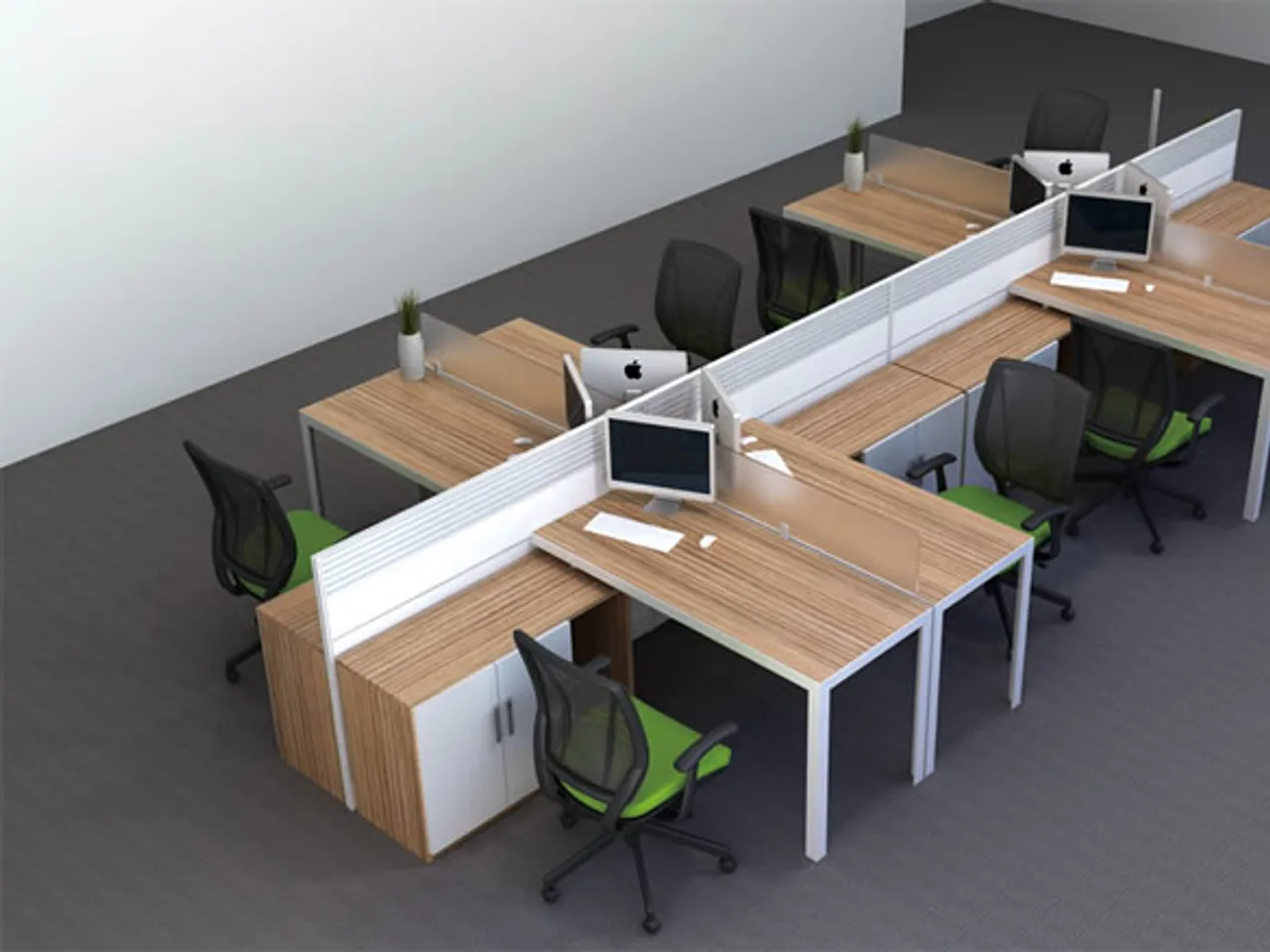
Most buyers come to us with a desk model in mind and a price in their head. The floor plan has usually already settled the harder questions — how big each desk can be, how many fit, and therefore how many we are building. So before I quote a workstation system, I ask for the plan and run the density math, because getting it wrong means re-ordering frames after the carpet is down and eating the freight on the difference.
The numbers planners actually use
There is no single right answer, but the published benchmarks cluster tightly. A common open-plan rule allows roughly 50 square feet per desk and another 50 square feet per person for circulation and shared space — so about 100 sq ft per head once you count the corridors. The 2026 planning guides land in the same place: individual contributors in open plans are usually given 100 to 150 square feet, and the metric guides quote 12 to 15 square metres per person for open-space layouts, dropping toward 8 to 10 sqm when the plan is tight.
The spread matters more than it looks. A call-center floor at 80–100 sq ft per person is a different desk program from a design studio at 150. The first wants a 1200 mm bench position; the second often needs a 1400–1600 mm worktop and a return. Same building, two completely different orders, and the only thing that decides it is the work the people do.
A worked example
Say you have 600 usable square metres and you want 50 people. That is 12 sqm per head — the upper-comfortable end of open plan, fine for knowledge work. Push the same floor to 70 people and you are at about 8.5 sqm each, which only works with 1200 mm benches, tight aisles and most storage pushed to a central bank rather than a pedestal at every desk. Both are buildable. But the 50-person plan and the 70-person plan are different furniture orders — different desk width, different screen count, a different number of pedestals — and quoting one when you will build the other is how a project ends up short.
Circulation is the number people forget
Here is where orders go wrong most often. Buyers count desks and forget that the gangway between back-to-back rows has to clear a seated person plus a passer-by — call it about 1500 mm centre-to-centre between facing desk edges on a main run, less on a secondary aisle. Pack the rows tighter to fit more desks and you fail the walkway; the chairs collide and someone in fire review fails the plan. We have watched a layout lose a whole row once the real circulation was drawn, which changed the order by a dozen positions and the price by more than the buyer had budgeted.
The trade-off: density versus desk size
This is the call I put to buyers plainly. You can run 1200 mm bench positions and pack more people in, which lowers your furniture cost per head and your rent per head — good for a back-office or a contact center. Or you give each person a 1400–1600 mm worktop and breathing room, which costs more per position and per square metre but is what a law firm or an engineering team expects. Neither is wrong. What does not work is ordering 1400 mm desks for a plan drawn at 1200 mm density — they will not fit, and you will be paying restocking and re-freight on the difference.
One lighter detail that still moves money: a back-to-back bench shares one frame and one cable spine between two people, so it is cheaper per seat than two free-standing desks, and it cubes better in the container because the cartons stack into clean rectangles. If your density is high, benching is usually the right structure before you even pick a finish.
Storage steals floor area too
One more thing the headcount target hides: where the storage goes. Put a pedestal under every desk and you have added roughly 0.3–0.4 sqm of footprint per person before anyone walks anywhere, which quietly pushes a tight plan over its density. The denser the floor, the more you want storage consolidated into a central bank of lockers or a credenza run rather than scattered under desks. It is the same furniture either way; the placement is what frees or eats the square metres. We flag this when a plan looks tight, because a pedestal per desk is the easiest thing to order by reflex and the easiest to regret.
How we quote against a plan
Send us the floor plate with rough headcount and we mark up a workstation layout — positions, desk width, and the realistic count after circulation — rather than just pricing the desk you named. That way the quantity on the quote is the quantity that fits. Our OEM/ODM team can match the worktop size and the screen height to the density you are planning, and we will flag if your headcount target needs a smaller desk than you asked for instead of letting you discover it on site.
Tell us the floor area, the headcount and the type of work, and we will return a workstation count with desk sizes that actually fit the plan. Reach the project desk through our contact form or write to [email protected]. Background on the factory is on our about page.