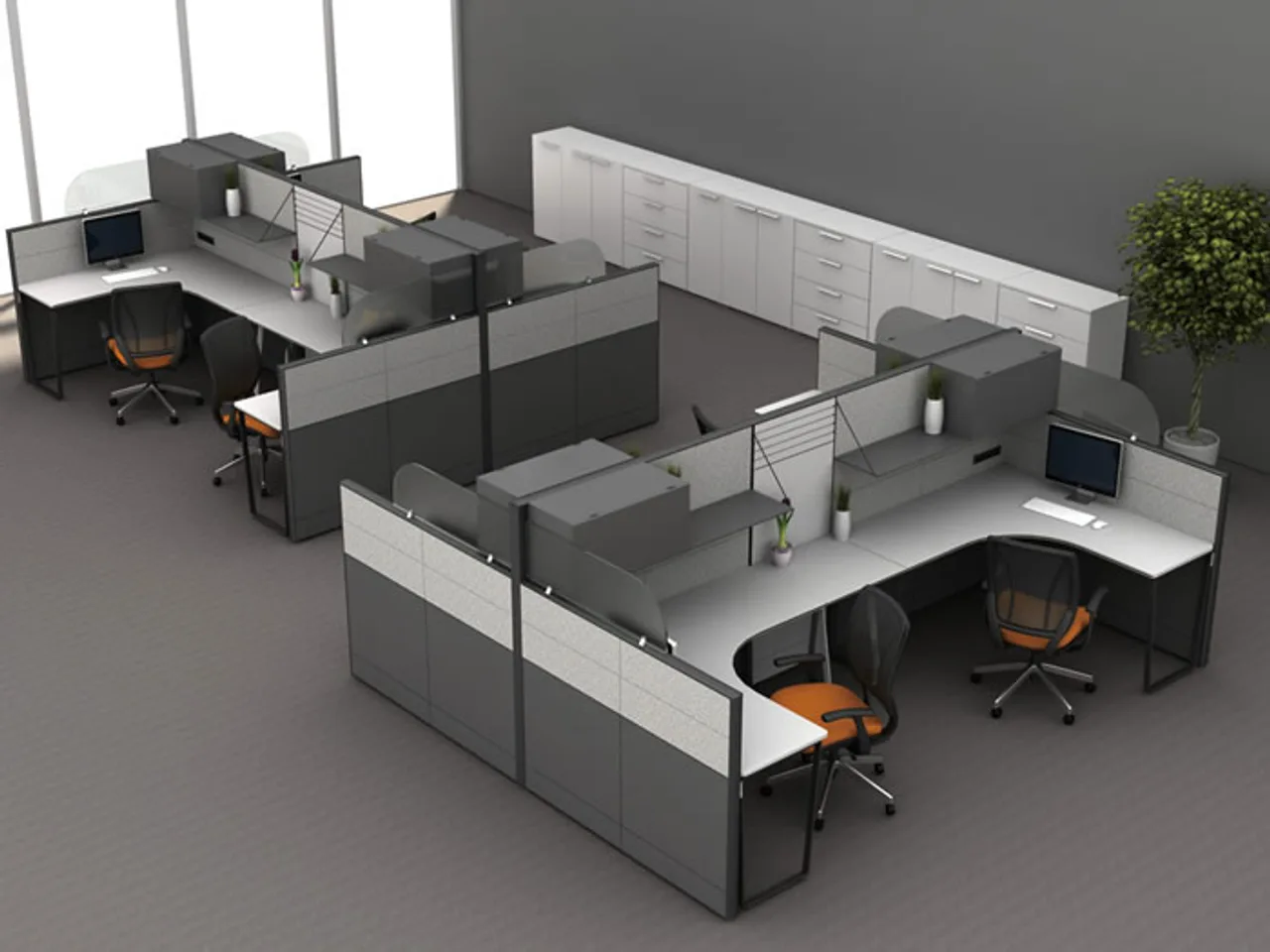
"Can you do acoustic screens?" is one of the first questions on an open-plan project, and it hides three different requests: visual privacy, sound absorption, and a finish that matches the desks. They are not the same spec, and a felt-wrapped board that looks the part can do almost nothing for noise. So when we quote screens for a workstation system, I push the conversation to the number that matters before we talk colour.
What NRC actually tells you
The Noise Reduction Coefficient (NRC) is a single figure between 0 and 1 for how much sound a surface absorbs rather than reflects. A hard glass divider sits near 0 — it blocks sightlines and bounces noise straight back into the room. A high-density PET felt panel commonly tests in the 0.7 to 0.95 range, which is where you get real absorption of the speech-frequency chatter that wears people down in open plan. The performance comes from the felt density and thickness, not the colour: a 9 mm panel absorbs less than a 24 mm one, and a soft thin felt absorbs less than its swatch suggests.
So the question to ask any screen supplier, us included, is not "is it acoustic" but "what is the tested NRC and at what thickness". A panel sold as acoustic with no NRC figure is decoration. If a project is being designed to a real acoustic target, the consultant will want that number, and a screen that cannot produce one will not survive the submittal.
PET felt, and the fire line you cannot skip
Most acoustic screens we build use PET felt — 100% polyester fibre, often pressed from recycled bottle stock, which is also an easy story for a green-building submission. The spec to pin down for a contract project is fire performance: acoustic felt is widely offered to ASTM E84 Class A in North America, and Europe asks for the EN 13501-1 class your tender names. Do not let "it's fire rated" stand on its own. Fire rated to which standard, and which class? That sentence is what an architect's submittal actually checks, and "fire rated" with nothing after it is a sentence that fails review.
Where the screen sits changes everything
Height is the other half of the decision, and it is where buyers over- or under-spend. A desk-mounted screen at 350–400 mm above the worktop gives seated visual privacy and keeps the open feel. A mid screen around 1200 mm starts blocking standing sightlines into a neighbour's monitor. A floor-standing screen at 1500–1650 mm gives standing privacy and the most absorption, but it cuts light and slowly turns an open plan back into cubicles — the layout it was meant to escape. Most floors do not need one height everywhere.
What a screen cannot do on its own
I tell buyers this so they do not over-buy: a desk screen absorbs, it does not block. Absorption stops sound bouncing around a hard room; it does not build a wall. If two people genuinely must not overhear each other — an HR corner, a finance pod, a doctor's bay — a felt screen is the wrong tool and you want a real partition or an enclosed room. Open plan with good screens gets you a calmer, less echoey floor where individual voices fade faster. It does not get you confidentiality, and a screen sold as if it does will disappoint the one person who needed it most. Match the tool to the requirement: screens for ambient calm, rooms for secrets.
The trade-off: privacy you can see versus privacy you can hear
Here is the choice I lay out. Tall absorptive panels everywhere will quiet the floor but darken it and cost the most. Low desk screens everywhere keep the light and the budget but do little once people stand and talk. The configuration most projects land on is a mid screen at the desk for seated privacy plus a few taller absorptive panels concentrated where the noise actually is — near the kitchenette, the print bay, the phone-call corner. Spend the acoustic budget where the noise is, not evenly across a floor that is mostly quiet anyway.
How we spec it on a project
Tell us the screen heights, the felt thickness and the fire class your project names, and we quote panels that meet it instead of a generic "acoustic" board. We build screen frames and felt to those methods and a test report can be arranged per order. Screen partitions integrate with our desk frames, so the heights and brackets are designed together rather than bolted on afterward — see how we develop a layout on the OEM/ODM page, or read our note on cable management since the same spine carries power past those screens. Start a thread through our contact form or [email protected].