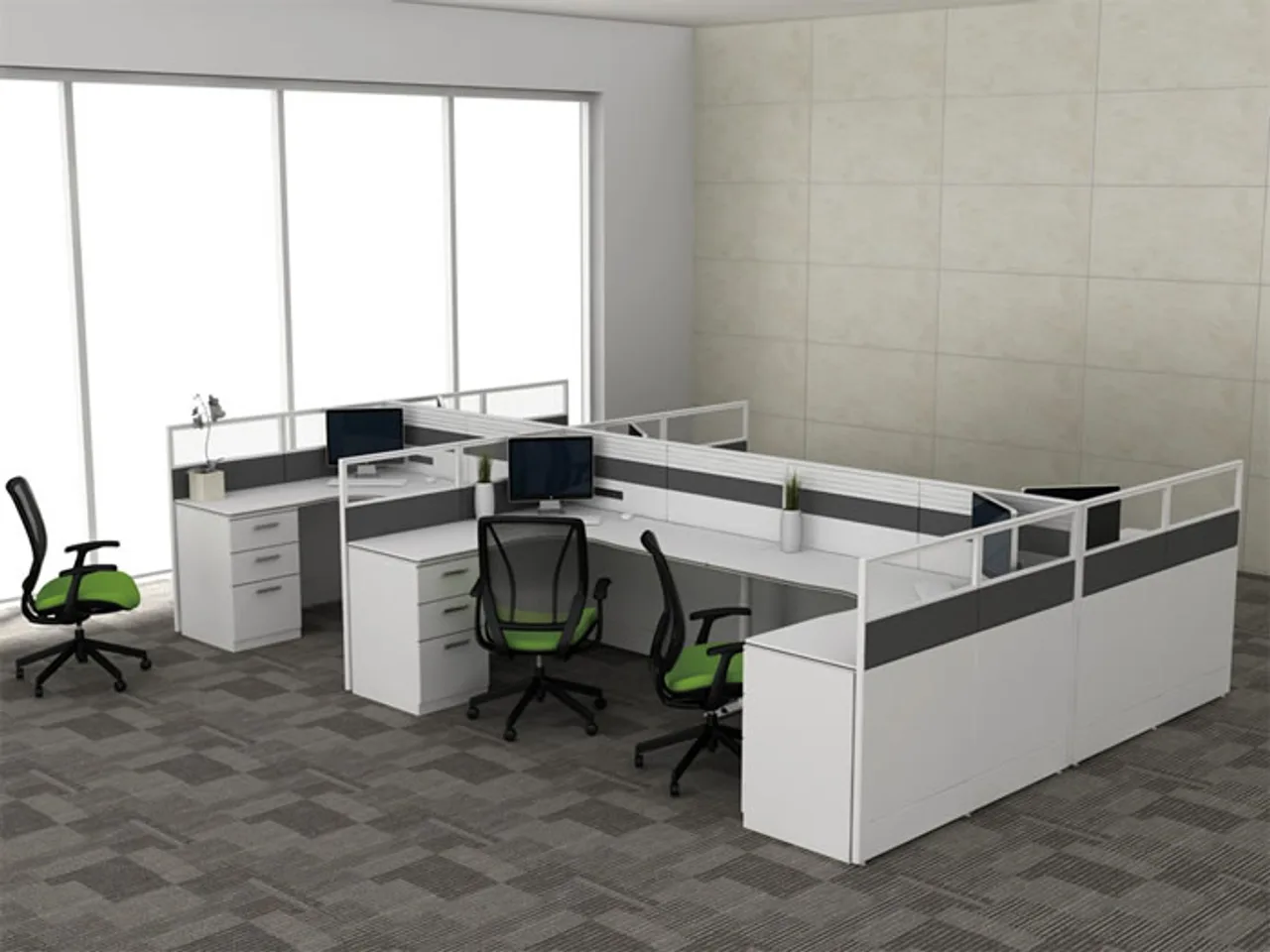
Every office tells me it is stable, and then it moves people around twice a year. Teams grow, projects spin up, someone joins and there is no desk, a department gets reorganised over a weekend. A bench desk system either absorbs that churn or fights it every single time, and which one you get is decided when you buy, not when you reconfigure.
What "modular" has to mean to be useful
Modular gets stamped on everything, so here is the test that matters: can you add one desk to a run without buying a whole new unit, and can you take one out without the row falling apart? A true bench system is built on shared frames — back-to-back rows hang off a common structure, and positions extend in standard increments (typically 1200, 1400, 1600 mm). Add a person and you bolt on one more bay and one more worktop; you do not order a fresh free-standing desk that does not match the others. The shared frame is also why benching is cheaper per seat and packs tighter in the container than the same number of separate desks. The other half of the test is the screen and the storage: if the dividing screen, the under-desk pedestal and the cable tray all clip to the same frame in standard positions, you can move them with the desk; if they are fixed to one specific worktop, the "modular" desk is really a fixed one with a marketing word on it.
Churn rate should change what you order
Be honest about your churn, because it changes the whole buy. A floor that reshuffles quarterly should standardise hard — one worktop size, one leg, one screen bracket — so any part fits any position, and it should carry a small stock of spare bays, brackets and grommets from the original production run. A stable floor that genuinely will not move for five years can afford more variety and skip the spares. The expensive mistake is the high-churn floor that bought three desk widths and four finishes to look interesting in the brochure, then could not move anyone without a mismatch and had to re-order the discontinued finish at a premium. Variety is the quiet enemy of reconfiguration.
Why spares from the same run matter
This is the part buyers skip and regret. Finishes drift between production batches, laminate decors get discontinued, a leg profile gets revised. If you buy the spares two years later, they may not match the desks on the floor — close enough to annoy, not close enough to pass. A small spares pack ordered with the original run, held by your facilities team, is the cheapest insurance on a churning floor. It costs a little container space now and saves a mismatched, half-replaced row later.
The reconfiguration nobody budgets for: labour
Even a good modular system has a labour cost when you move it, and buyers forget to count it. The difference between systems is whether that labour is your own facilities person with a hex key on a Friday afternoon, or a paid installer with a van and a day rate. A bench that breaks down and rebuilds with common fixings and no special tools keeps the move in-house and cheap. One that needs the cam locks lined up just so, or panels that only fit one way and are unmarked, turns every move into a service call. When we standardise a system we keep the fixings common and the parts marked, because the point of modular is that your own team can do the move — not that you have bought the right to pay someone else to.
The trade-off: flexibility versus unit cost and lead time
Here is the call. A fully standardised modular bench costs a little more up front than the cheapest fixed desk, and you are buying fewer variations than a designer might want on the moodboard. What you get back is years of free reconfiguration — moves done by your facilities team with an Allen key instead of a new purchase order and a lead time each time. For an organisation that genuinely churns, that pays for itself inside the first couple of moves. For one that truly does not, the simpler fixed desk is the honest cheaper buy, and I will tell you so rather than upsell modularity you will never use.
How we set you up for it
Tell us your real churn and headcount trajectory, and we standardise the system, hold the part list, and quote a sensible spares pack so a future reorder matches the desks already on the floor — no "that finish was discontinued" surprise. We keep your configuration on file against the next order. Pair this with our note on workstation density so the standard width suits your plan, and see how we lock a specification on the OEM/ODM page. Start at our contact form or [email protected].